

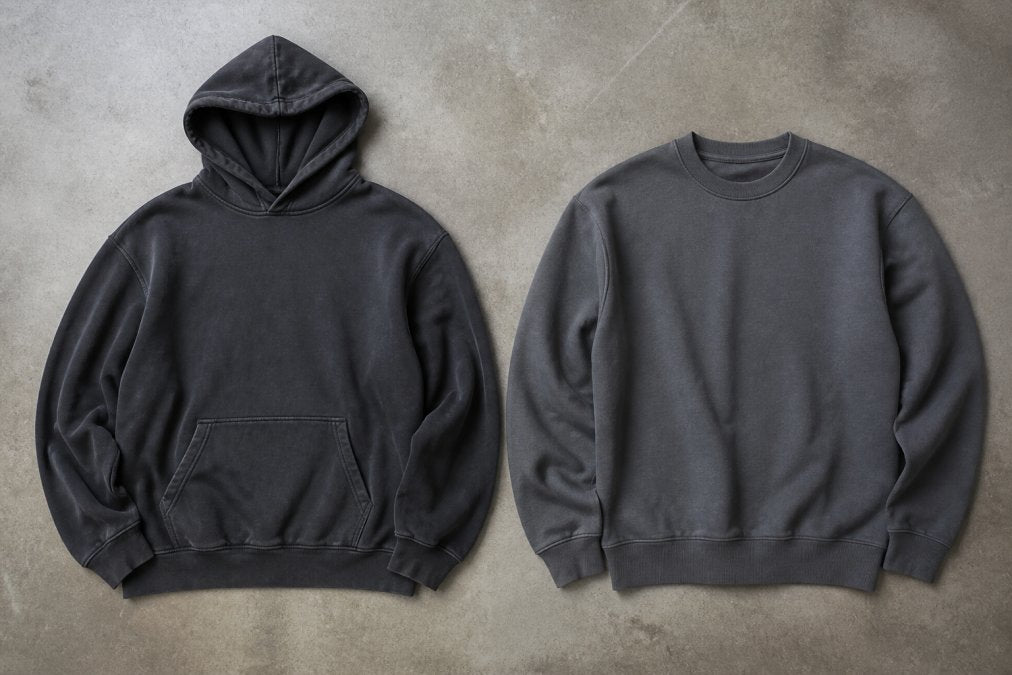
Streetwear Hoodies vs Crewnecks for Layering
Table of Contents
- Streetwear Hoodies vs Crewnecks: The Core Differences
- How to Layer Hoodies for Men Without the Bulk
- Best Heavyweight Hoodies for Men: What to Look For
- Styling Crewneck Sweatshirts for a Polished Streetwear Look
- Fabric Weight, GSM, and Thermal Performance
- Outerwear Compatibility: What Layers Over Each
- Body Type, Fit, and Care Considerations
- Frequently Asked Questions
Last Updated: September 12, 2026
Streetwear Hoodies vs Crewnecks: The Core Differences
Streetwear hoodies vs crewnecks for layering comes down to one structural fact: a hood adds volume at the neck and shoulders, while a crewneck keeps the neckline flat. That difference determines which pieces layer cleanly under outerwear. This EVRMORE guide breaks down fabric weight, fit, and outerwear compatibility.
The hood is the dividing line. A hoodie carries a double-layer hood and often a heavier body, adding bulk exactly where a jacket collar sits. A crewneck has no hood, no drawstrings, and a flat ribbed neckline, so it disappears under a coat.
That distinction matters more than most style advice admits. According to Textile Exchange's material and fiber guidance, fabric weight and fiber blend drive how a garment drapes and insulates, which is precisely what determines whether a layer stacks cleanly or bunches up.
Most guides get this wrong: hoodies and crewnecks aren't interchangeable. One is a mid-layer with built-in structure; the other is a base or finishing layer that stays out of the way.
Below: how to choose between them, layer each without bulk, and which fabric weights hold up under real outerwear.
| Factor | Hoodie | Crewneck |
|---|---|---|
| Neckline | Hood + double layer | Flat ribbed crew |
| Bulk at collar | High | Low |
| Best layer position | Outer or standalone | Mid or base |
| Drawstrings | Sometimes (EVRMORE uses none) | None |
| Under a jacket | Fights the collar | Sits flat |
| Warmth | Higher | Moderate |
| Streetwear role | Statement piece | Clean foundation |
How to Layer Hoodies for Men Without the Bulk
Layering a hoodie without bulk starts with fit, not fabric. A hoodie tight in the shoulders will bunch the moment you add a jacket. You want a relaxed cut with dropped shoulders so the fabric drapes instead of compressing.
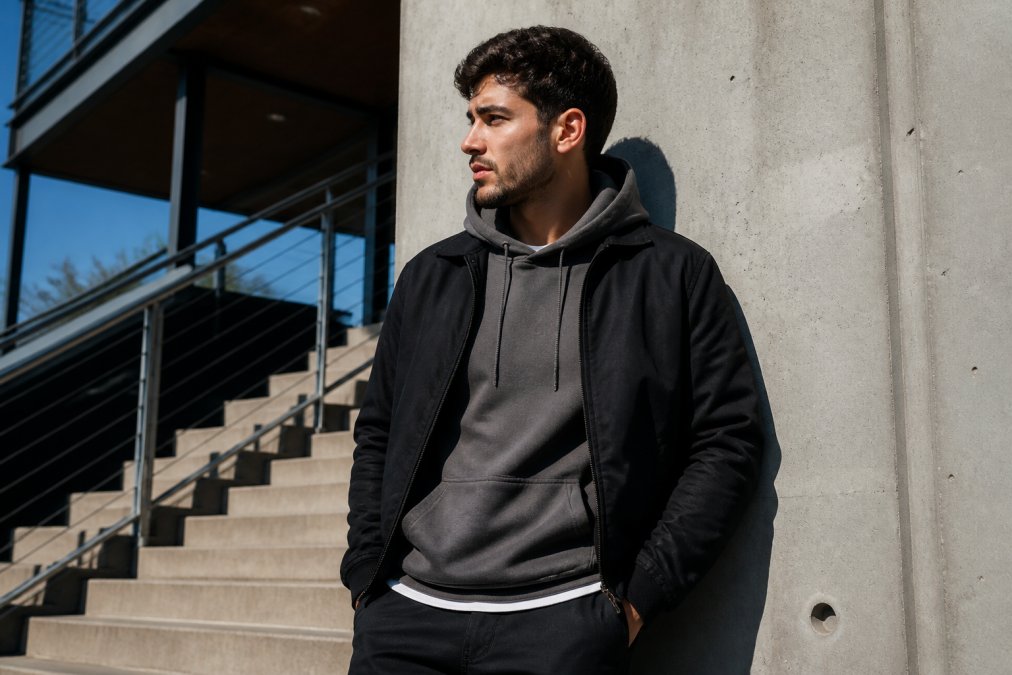
Three rules keep the silhouette clean:
- Choose a hoodie with no drawcords.
- Size for the layer beneath. If you wear a tee under the hoodie, the hoodie should still have room in the chest.
A common mistake is layering a heavyweight hoodie under a slim jacket: the jacket pulls at the shoulders and you look stuffed rather than styled. If your outerwear is slim, switch to a crewneck as your mid-layer.
Best Heavyweight Hoodies for Men: What to Look For
The best heavyweight hoodies for men balance three things: fabric weight, shape retention, and a cut that layers. Weight gives warmth and drape, shape retention keeps the piece from stretching out, and cut decides whether it works under anything.
Fabric weight is measured in GSM (grams per square meter) or ounces per square yard. A standard mid-weight hoodie sits around 8 to 10 oz; heavyweight starts around 12 oz. The EVRMORE What Broke Me Heavyweight Hoodie is built at 16.5 oz / 560 GSM heavyweight French terry, firmly top tier. Heavier fabric drapes with structure instead of clinging, which makes a layer look intentional.

Shape retention comes from ribbing and construction: ribbed cuffs and waistbands with spandex, single-needle topstitching at the neckline, and pre-shrunk fabric.
A relaxed fit with dropped shoulders gives you room to layer without sizing up. The Built Stronger Fleece Hoodie in Sandstone, at $85, uses a relaxed ReFlex fit with dropped shoulders and an oversized pouch pocket. The Bedrock colorway at $85 uses the same relaxed minimalist build.
Styling Crewneck Sweatshirts for a Polished Streetwear Look
Styling crewneck sweatshirts for a polished look means treating them as the quiet layer. A crewneck's flat neckline reads cleaner than a hood, so it works where a hoodie feels too casual.
The trick is contrast. Pair a crewneck with structured outerwear, tailored trousers, or a crisp collared shirt underneath. The flat neckline lets a collar sit naturally, which a hood never will.
For layering, a crewneck under an open jacket or over a button-down gives you a mid-layer that stays put. The Built Stronger Fleece Crewneck Sweatshirt in Sandstone, at $70, uses a 70/30 combed ring-spun cotton and recycled polyester blend with 1x1 rib and spandex at the cuffs and hem, which stops the neckline and hem from stretching out.

Color does a lot of work here. A neutral crewneck in Slate or Black reads more polished than a graphic-heavy piece. If the crewneck carries a graphic, keep it to a chest emblem and a sleeve print rather than a full front statement.
Fabric Weight, GSM, and Thermal Performance
GSM and thermal performance are linked by a simple mechanism: fabric traps air, and trapped air insulates. More grams per square meter means more loft and more warmth per square inch, the part most style guides skip, and the part that decides whether your layering system works or just feels heavy.
Here is how the weights behave in practice, including what each one does when you stack a shell over it:
| Weight Range | Construction Cue | Layer Position | Relative Warmth | Behavior Under a Shell |
|---|---|---|---|---|
| 8-10 oz (270-340 GSM) | Light loopback or thin terry | Base or standalone | Low | Compresses flat, adds almost no bulk |
| 11-13 oz (370-440 GSM) | Standard heavyweight terry | Mid-layer | Moderate | Holds shape, minimal collar push |
| 14-16 oz (475-540 GSM) | Dense French terry, brushed interior | Mid or outer | High | Fills the jacket, needs a relaxed collar |
| 16.5 oz / 560 GSM | Top-tier heavyweight French terry | Outer or standalone | Highest | Best worn as the outermost layer |
Heavier fabric feels warmer not just because of thickness. A brushed or looped fleece interior traps still air against your body, the actual insulator, while a tightly woven face fabric blocks wind from stripping it away. That is why a 16.5 oz / 560 GSM French terry hoodie holds heat noticeably longer than an 8 oz loopback crew of the same cut.
Fiber blend changes the math. A 70/30 combed ring-spun cotton and recycled polyester blend resists shrinking and holds shape better than 100% cotton, a layer that shrinks stops fitting under the jacket you bought it for (peer-reviewed research). An 80/20 cotton-poly heavyweight build traps air without all-cotton bulk and dries faster when you sweat.
Breathability is the trade-off nobody mentions. A layer that traps heat but cannot vent moisture leaves you clammy indoors. Looped fleece interiors and unlined hoods vent better than tightly woven shells, which is why a heavyweight hoodie with an unlined hood often feels more comfortable all day than a lighter piece with a bonded lining.
A practical rule: match GSM to the layer above it, not the temperature alone. If your outerwear is slim, cap your mid-layer around 11-13 oz so it compresses instead of fighting the seams. If your outerwear is relaxed or oversized, run a 14-16 oz mid-layer and let the loft insulate.
Outerwear Compatibility: What Layers Over Each
Outerwear compatibility settles the hoodie-versus-crewneck decision, and it comes down to collar geometry. A crewneck's flat ribbed neckline sits below the jacket collar, so the jacket closes the way it was cut to. A hoodie's double-layer hood occupies the same space as the jacket collar, pushing it up and back and distorting the shoulder line.
Here is how specific jacket types behave over each sweatshirt style:
| Outerwear | Over a Crewneck | Over a Hoodie | Why |
|---|---|---|---|
| Bomber jacket | Clean | Workable if the hood is thin | Ribbed bomber collar sits flat over a crew; a hood pushes it up |
| Denim jacket | Clean | Fights the collar | Denim has no stretch, so hood bulk strains the yoke |
| Trench coat | Clean | Not recommended | Structured collar and lapel need a flat neckline underneath |
| Leather jacket | Clean | Not recommended | Snug armholes and stiff leather leave no room for hood volume |
| Chore coat | Clean | Workable if sized up | Boxy cut tolerates a mid-weight hood |
| Parka | Clean | Ideal | Parka hood and roomy collar are built for a hood underneath |
| Oversized puffer | Clean | Ideal | Quilted volume absorbs hood bulk without strain |
| Coach jacket | Clean | Workable | Relaxed collar and roomy body accommodate a hood |
| Blazer or sport coat | Clean | No | Tailored shoulder and lapel cannot absorb hood volume |
A few rules fall out of that matrix:
- Structured outerwear wants a crewneck. Trench coats, leather jackets, blazers, and denim jackets all have a fixed collar shape. A flat ribbed neckline lets that collar do its job.
- Relaxed outerwear can take a hoodie. Parkas, oversized puffers, and coach jackets have room in the collar and body, so a hood adds warmth without wrecking the line.
- Match weight to the shell. A 16.5 oz / 560 GSM hoodie under a slim bomber will pull at the shoulders and strain the seams. Reserve heavyweight pieces for outer-layer duty or pair them with relaxed shells.
- Under a hoodie, keep the base thin. A fitted tee or a thermal base layer works. A stiff collared shirt does not, because the collar fights the hood.
A common mistake is forcing a hoodie under a tailored coat: the hood pushes the collar away from your neck, the lapels gap, and the whole thing reads a size too small. For the coat-and-layer look, the crewneck is the answer every time.
Body Type, Fit, and Care Considerations
Body type and fit determine which cut flatters you; care determines whether the piece still fits a year from now. Both get ignored in most comparisons.
For body type, the rule is proportion. A boxy, dropped-shoulder cut adds width at the shoulders and chest, building a fuller silhouette if you're lean. If you're broader through the chest, a relaxed fit can read as oversized, so size down or choose a classic fit with raglan sleeves.
The EVRMORE What Broke Me Heavyweight Hoodie uses a classic fit with raglan sleeves and a structured shoulder. Order your usual size, or size down if you want a closer fit.
Care is where cheap garments fail. To protect shape and neckline:
- Wash cold, inside out
- Skip the dryer; hang dry to prevent shrinkage
- Never bleach
- Don't iron directly over prints
- Fold rather than hang heavy knits to avoid shoulder stretch
Ribbed cuffs and hems with spandex are the biggest defense against a stretched-out neckline. Without that ribbing, expect the collar to lose shape within a season.
American Cleaning Institute laundry care guidance recommends washing similar fabrics together and avoiding high heat, which preserves fiber structure and color in heavyweight knits.
Choosing between hoodies and crewnecks isn't about picking a favorite. It's about matching the layer to the job: crewnecks for clean mid-layers under structured outerwear, hoodies for standalone warmth and streetwear statement. At EVRMORE, we build both with the same priorities: heavyweight fabric, shape-holding ribbing, and a relaxed cut with dropped shoulders that layers without bulk. The Built Stronger collection carries premium heavyweight construction, message-driven graphics, and colorways like Black, Vintage Pearl, and Slate. Get started with EVRMORE and build a layering rotation that holds its shape as long as you do.
Frequently Asked Questions
What's the difference between a crew neck and a hoodie?
A crewneck has a round ribbed neckline with no hood or pocket, while a hoodie adds a hood, drawstrings or a clean no-drawcord front, and often a kangaroo pocket. For streetwear layering, the crewneck sits flatter under jackets and coats, while the hoodie adds warmth and a bulkier silhouette. Both work as mid-layers; the choice comes down to how much structure and coverage you want on any given day.
How do you style a hoodie under a jacket without looking bulky?
Start with a mid-weight or heavyweight hoodie that has a structured drape rather than a loose, floppy fit. Choose a jacket with a slightly roomier cut through the chest and shoulders so the hoodie doesn't compress the fabric. Keep the hood out of the collar if possible, or use a no-drawcord hoodie like EVRMORE's Built Stronger fleece hoodie for a cleaner front. Stick to one bulky layer per outfit.
Which is more versatile for streetwear: a heavyweight hoodie or a crewneck?
A crewneck tends to be more versatile because it layers cleanly under blazers, overcoats, and lighter jackets without adding a hood bump. A heavyweight hoodie works better as a standalone piece or under a heavier coat in cold weather. For a capsule wardrobe, one of each covers more outfit combinations than two of the same type. EVRMORE's crewneck at $70 and heavyweight hoodie at $90 are both built for repeated wear.
What are the benefits of heavyweight fabric in streetwear layering?
Heavyweight fabric holds its shape instead of collapsing under outerwear, which keeps your silhouette cleaner when you layer. A 16.5 oz French terry hoodie like EVRMORE's What Broke Me heavyweight hoodie drapes with structure and resists the stretched-out look that lighter fleece gets after a few washes. Heavier fabric also traps more warmth, so you can wear fewer layers underneath without sacrificing comfort in cold weather.
Can you wear a crewneck over a t-shirt for a layered look?
Yes, and it's one of the easiest streetwear layering moves. Wear a heavyweight tee underneath and let the collar and hem peek out for a visible layered effect. Keep the tee fitted so it doesn't bunch under the crewneck. A relaxed crewneck with dropped shoulders, like EVRMORE's Built Stronger fleece crewneck, works well over a tee because the extra room prevents the fabric from pulling and keeps the silhouette clean.

Leave a comment
This site is protected by hCaptcha and the hCaptcha Privacy Policy and Terms of Service apply.