


Psychological Benefits of Wearing Inspirational Quotes
Table of Contents
- Why Wearing Inspirational Quotes Affects How You Think
- The Psychological Benefits of Affirmations You Can See
- Positive Affirmations for Self-Esteem and Confidence
- How Inspirational Quotes Support Stress and Emotional Well-Being
- How to Choose a Personal Affirmation That Actually Sticks
- Motivational Quote Clothing: What to Look For and What to Avoid
- Limits, Risks, and How Long the Effect Lasts
- Frequently Asked Questions
Last Updated: October 18, 2026
Why Wearing Inspirational Quotes Affects How You Think
Motivational quote clothing works as a wearable cue: a short, visible message that interrupts a negative thought loop and pulls your attention toward a goal you already care about. The psychological benefits of wearing inspirational quotes come from repetition and visibility, not the fabric.
Here's the honest version: most claims about quote apparel outrun the evidence. There's no research specifically on wearing inspirational quotes, only on affirmations, self-affirmation, and environmental cues, and that research is suggestive rather than conclusive.
So treat this as a practical guide: what the psychology supports, where it falls short, and how to pick a piece you'll still want in six months.
The Difference Between Reading a Quote and Wearing One
Reading a quote is a single event. Wearing one is a repeated exposure.
That distinction matters. A quote you scroll past competes with everything else on your screen for a few seconds. A quote on your chest shows up in the mirror, in photos, and in shop-window reflections, part of the environment rather than a moment you seek out.
There's a second difference most guides skip: wearing a message makes it public. You're not just reminding yourself; you're signaling something about your identity to everyone who sees it. That social layer is where quote apparel gets interesting, and where it gets risky.
The Psychological Benefits of Affirmations You Can See
The strongest case borrows from self-affirmation research, which finds that reflecting on personal values reduces defensive reactions to stress and helps people hold perspective under pressure (pubmed.ncbi.nlm.nih.gov). The psychological benefits of affirmations follow similar logic: brief, repeated statements connecting you to something you value.
A visible affirmation adds two things to that formula.
- Frequency. You encounter it without deciding to, which removes the discipline problem that sinks most journaling and meditation habits.
- Concreteness. A phrase tied to a specific object is easier to recall than an abstract intention. The shirt becomes the retrieval cue.
Don't expect a mood shift from the fabric alone. The benefit comes from what the reminder triggers: a pause, a reframe, a small decision to keep going.
Positive Affirmations for Self-Esteem and Confidence
Positive affirmations for self-esteem tend to work best when they're specific and believable, not sweeping. "I am unstoppable" asks you to argue with it on a bad day. "I've rebuilt before, I can rebuild again" doesn't.
That's the practical test for any message-driven piece: does the phrase describe something you've done, or something you're trying to become? The first builds confidence because it's anchored in evidence; the second feels hollow, and hollow reminders get ignored.
Confidence here isn't a feeling you install, it's the accumulated effect of small moments where you behaved like the person you're trying to be.
How Inspirational Quotes Support Stress and Emotional Well-Being
Inspirational quotes support stress management by interrupting rumination, the repetitive negative thinking that keeps a difficult moment looping long after it's over.
The mechanism matters, because "it distracts you" undersells it.
That's why wording matters more than intensity. "Stay positive" asks you to suppress what you're feeling, which tends to backfire under stress.
The emotional well-being angle is subtler. Many people managing anxiety or difficult seasons describe needing something external to hold onto when internal reassurance isn't available.
A few practical patterns show up again and again:
- Pair the quote with one action. A reminder works best when it's tied to something you can do in under five minutes, a breath, a text, a glass of water, a walk to the mailbox. The phrase cues the action; the action does the work.
- Keep it where your eyes already go. Chest-height prints get seen in mirrors and reflections. A message on a sleeve or back gets seen by other people more than by you.
- Rotate rather than overload. One clear message per garment beats three competing lines. Worn daily, the phrase fades into the background within weeks, that's normal.
- Match the message to the season. During acute stress, understated language tends to hold up better than rallying cries. "Keep going" wears well on a hard Tuesday; "Crush every obstacle" can feel like pressure when you're already depleted.
If you're dealing with significant anxiety or depression, treat apparel as a supplement to real care, never a substitute. That distinction keeps the whole conversation honest.
Validation, Shared Experience, and Feeling Understood
Feeling understood is an underrated, mostly social benefit. When someone reads your shirt and responds, even with a nod, you get a small piece of validation: someone recognized the thing you're carrying.
That's the shared-experience effect. Recovery communities, faith groups, and people rebuilding after a hard chapter tend to recognize each other through signals.
The flip side: a visible message can invite unwanted attention. A phrase that reads as vulnerable to you may read as an invitation for strangers to comment, advise, or ask questions you didn't want to answer.
How to Choose a Personal Affirmation That Actually Sticks
Choosing a personal affirmation is a filtering exercise, not a search for the perfect sentence. Run candidates through these five questions:
- Does it describe something you've actually done, or something you're actively working toward?
- Would you be comfortable if a stranger read it and asked about it?
- Does it still feel true on a bad day, not just a good one?
- Is it short enough to read in one glance?
- Does it point forward rather than dwelling on what happened?
Pass all five and it's a candidate; fail two or more and keep looking. The right affirmation feels slightly understated at first, then more accurate the longer you sit with it.
One more filter we'd add: choose language you'd actually use out loud. Phrases that sound like a greeting card get tuned out within a week.
Motivational Quote Clothing: What to Look For and What to Avoid
Motivational quote clothing earns its place when the garment holds up as clothing first and the message second. A piece that fades, stretches, or feels thin turns a meaningful reminder into a chore you avoid wearing.
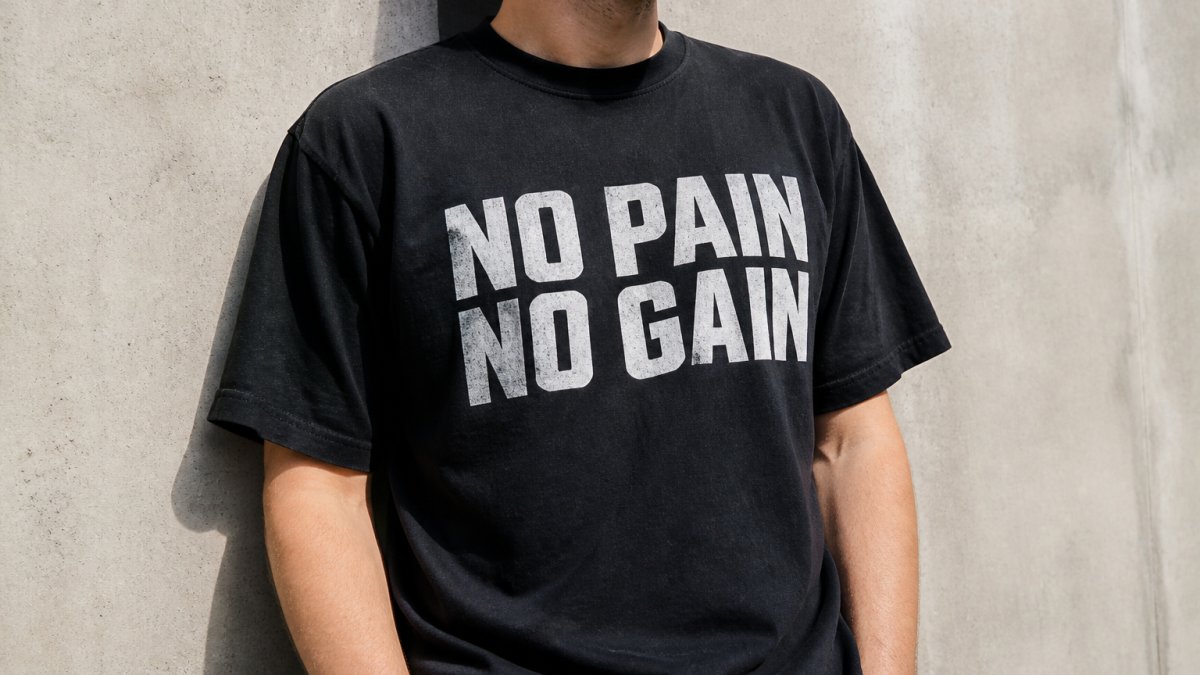
What to look for:
- Heavyweight fabric with structure. A substantial cotton holds its shape and drapes cleanly, so the print reads as intentional rather than cheap.
- Print quality that survives washing. Direct-to-film and similar processes hold detail better than thin screen jobs when cared for properly.
- A cut you'll actually reach for. Boxy, dropped-shoulder fits work for streetwear styling, but only if the sizing is honest. Check the size chart against a garment you already own.
- A message that fits your stage. Early in a rebuild, a loud statement can feel like a costume. Muted colorways with a smaller front hit let you wear the reminder without making it the whole conversation.
What to avoid:
- Phrases so broad they could belong to anyone
- Prints positioned where a bag strap or jacket will constantly rub
- Fabric descriptions that don't specify weight or construction
- Anything that requires special washing you won't keep up with
That last point is where we'd put our own money. EVRMORE's Built Stronger Tee is a premium heavyweight blank with a boxy, dropped-shoulder cut and a center chest graphic, priced at $45.00 in Black, Vintage Pearl, and Slate.

American Psychological Association resources on stress and coping
Limits, Risks, and How Long the Effect Lasts
The effect of a wearable reminder is modest and it fades. That's the honest answer, and it's worth stating plainly because the alternative is disappointment.
Three limits worth knowing:
Habituation. Anything you see constantly stops registering, the same process that makes a new ring or wall clock invisible after a few weeks. Rotating pieces, or storing one away for a few weeks, restores some of the signal. Two or three message pieces in rotation beats one worn daily.
Individual differences. Some find visible affirmations motivating; others find them performative or embarrassing. Neither is a character flaw.
Social cost. A bold message invites comments, questions, and occasionally unwanted opinions. If you don't want that attention, choose a subtle piece or skip the message for now. Workplace and school norms matter too: a message that reads as motivating casually can read as a statement in a formal setting.
How Long the Effect Lasts, and How to Tell If It's Working
Expect the strongest effect in the first weeks, then a gradual settling into background, the reminder doesn't stop working so much as it stops surprising you.
What you can do is watch for realistic indicators rather than waiting for a mood transformation:
- A shorter pause before you act. You catch yourself mid-spiral and do the small thing, send the text, take the walk, close the laptop, a little sooner than you would have.
- A reframe you notice after the fact. You realize you talked yourself down from a familiar worry and the phrase on your chest was part of what started it.
- Follow-through on a stated intention. If the message names a behavior, the indicator is whether you did the behavior more often in the weeks after you started wearing it.
- A comment from someone else. If a stranger or coworker responds to the message, that's the social layer working, though it's a signal about visibility, not about your internal state.
What not to use as a measure: whether you feel dramatically better on any given day.
A simple test: wear a message piece for two weeks, then put it away for two weeks, and notice whether the small behaviors above change. If they don't, the piece isn't earning its place in your rotation, and that's useful information, not a failure.
National Institute of Mental Health guidance on coping and emotional health
Frequently Asked Questions
Can wearing inspirational quotes improve your mood?
A visible reminder can nudge your attention toward a message you already believe in, which may lift your mood in the moment. The effect is small and short-lived, and it depends on whether the words feel true to you. A quote you find hollow or preachy tends to do nothing, or worse, feels like a costume. Treat quote apparel as a cue that reinforces a mindset you are already building, not as a treatment for low mood or a substitute for professional care.
What are the psychological benefits of motivational quote clothing?
The main benefits are attentional: a worn message keeps a chosen idea in your line of sight, which supports focus on goals, reinforces self-concept, and can steady you during stressful moments. Wearing a statement also opens small social exchanges, and being seen with a message you chose can support self-expression and identity. These are reinforcement effects, not cures. They work best alongside therapy, community, and habits you already practice, and they fade if the message stops matching where you are.
How do you choose a personal affirmation that feels meaningful?
Start with language you would actually say out loud, not language that sounds impressive. Pick a phrase tied to a specific change you are working on, keep it short enough to read at a glance, and test it for a week before committing to it on a garment. If the words make you cringe or feel like a claim you have not earned, rewrite them. The best personal affirmation describes direction, not a finished result, which is why phrases like forward is the only direction tend to hold up longer than grand declarations.
What should you look for in inspirational clothing?
Check three things: the message, the construction, and the fit. The message should match where you actually are in your journey, so early on a subtle chest graphic may serve you better than a full back statement. Construction matters because a shirt that pills, fades, or loses its neckline shape after a few washes stops being a reminder and becomes clutter. Look for heavyweight fabric, a print method that survives washing, and a cut you will reach for daily rather than save for occasions.

Leave a comment
This site is protected by hCaptcha and the hCaptcha Privacy Policy and Terms of Service apply.