

How to Measure Inseam for Streetwear Pants
Table of Contents
- Why Streetwear Inseam Is Different From Denim Sizing
- What You'll Need Before You Measure Inseam
- How to Measure Your Inseam: Body Measurement Step by Step
- How to Measure Inseam on Pants: Garment Measurement Explained
- Baggy Pants Inseam Length: How Much Extra You Actually Need
- Stacked Pants Length: Dialing In Drape and Footwear
- Common Inseam Measurement Mistakes to Avoid
- Putting Your Inseam to Work in a Streetwear Fit Guide
- Frequently Asked Questions
Last Updated: October 12, 2026
Why Streetwear Inseam Is Different From Denim Sizing
Streetwear pants do not fit like jeans. A denim inseam sits close to your ankle; a streetwear inseam is cut long on purpose so the fabric stacks, drapes, or breaks over a sneaker.
This EVRMORE guide walks through how to measure inseam for streetwear pants in about five minutes with one flexible tape measure.
The key idea: body inseam is your actual leg length, crotch to ankle bone. Garment inseam is the sewn length of the pant from crotch seam to hem.
What You'll Need Before You Measure Inseam
Gather four things before you start.
- A flexible tape measure, cloth or retractable
- A full-length mirror, or a friend to help
- A pair of pants you already like the fit of
Skip the metal carpenter's tape; it does not bend around a leg or follow a seam. A soft tailor's tape gives an accurate leg measurement.
If you do not have a tape measure, a piece of string and a ruler work fine. Mark the string, then measure it flat.
How to Measure Your Inseam: Body Measurement Step by Step
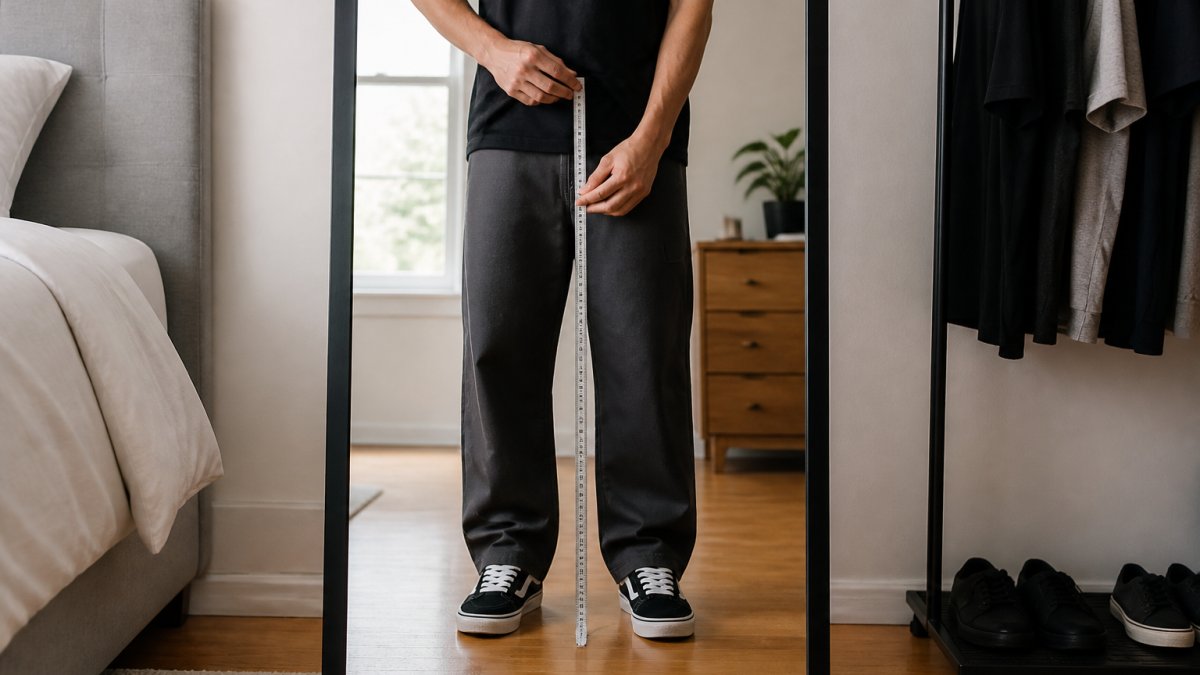
Stand up straight and measure your leg from crotch to ankle bone. This is your body inseam, the starting point for every streetwear sizing decision.
Standing Position and Tape Measure Placement
Stand with your feet shoulder-width apart and your weight even on both legs.
Find your crotch point, where the inner leg meets the torso at the seam of your pants, and place the top of the tape there.
Run the tape straight down the inner leg to your ankle bone, snug but not tight, following the natural line of your leg.
Reading the Number Without Rounding Up
Read the number at the ankle bone, not the floor, and write it down to the nearest quarter inch. Do not round up; small gaps add up fast in a size chart.
Measure both legs; most people differ slightly. Use the longer measurement for streetwear, since extra length is easier to work with than a short hem.
How to Measure Inseam on Pants: Garment Measurement Explained
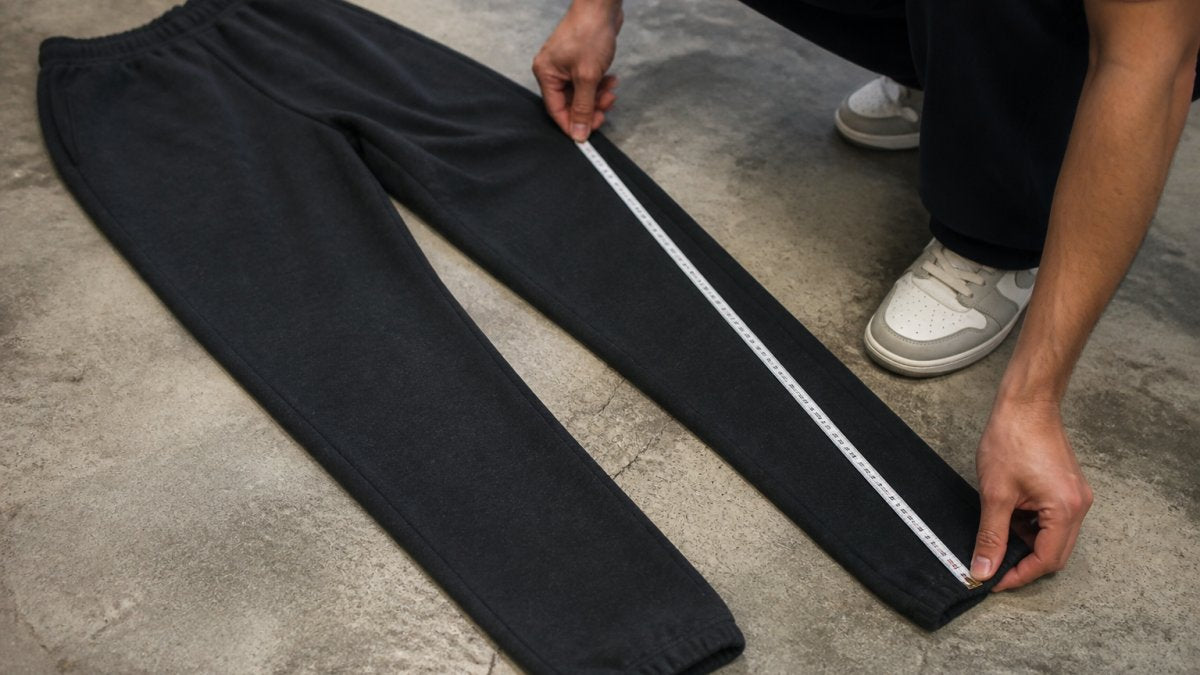
Garment inseam is the sewn length of the pant from crotch seam to hem, not your leg length, not the outseam. On streetwear pants it decides whether the hem breaks clean, stacks, or pools, so measure it the same way the brand did.
Finding the Crotch Point on Different Constructions
Lay the pants flat and smooth the inner leg so the fabric lies even, with no twist.
Find the crotch point: the spot where the two inner leg seams meet. On a standard five-pocket or flat-front pant, that is a single, obvious intersection. Streetwear is not always standard:
- Curved crotch seam: On joggers and tapered sweatpants, the crotch seam curves forward. The true crotch point is the lowest point of that curve where the two leg seams actually join, not the top of the curve where it meets the rise.
- Gusseted crotch: A diamond or oval gusset inserts extra fabric between the legs. The crotch point is the bottom corner of the gusset, where the inseam begins. Measuring from the top of the gusset adds an inch or more of phantom length.
- Dropped crotch: On drop-crotch and harem-style pants, the seam sits well below the body's natural crotch. The garment inseam will read short even though the pant is long, because the rise is eating the length. A dropped-crotch pant with a 26-inch garment inseam can hang lower than a standard pant with a 30-inch inseam.
If you cannot find the join by eye, turn the pant inside out, the seam intersection is clearer.
Measuring Along the Seam, Not Across the Leg
Place the top of the tape at the crotch point and run it down the inseam seam itself, following the stitching to the hem.
Keep the tape flat and let it trace every curve rather than bridging it.
Measure both legs of the same pair. A quarter-inch difference is normal; a half-inch or more usually means the panels were cut off-grain and the pant will hang unevenly.
Cuffs, Taper, and Hem Finish
A finished hem and a raw hem measure the same at the seam but read differently on the body. A ribbed jogger cuff pulls the hem up and shortens effective length by an inch or more; a raw or rolled hem changes where the fabric ends visually.
When you compare two pants, compare like finishes. A 29-inch inseam on a cuffed jogger and a 29-inch inseam on an open-hem wide-leg are not the same fit.
Reading the Size Chart, Shrinkage, and Tolerance
A size chart lists the garment inseam per size, but that number is a target, not a guarantee. Two adjustments matter:
- Tolerance: Most brands allow roughly a quarter to a half inch of variance per measurement, because fabric shifts during cutting and sewing. A chart that lists 30 inches may ship anywhere from about 29.5 to 30.5 inches.
- Shrinkage: Cotton and cotton-blend streetwear pants can shrink along the length after the first wash, especially in hot water or a hot dryer. A common pattern is roughly a quarter to a half inch of inseam loss on an untreated cotton fleece. If the chart lists a pre-wash measurement, subtract that before comparing.
Compare your body inseam to the chart's garment inseam. The gap tells you how the pant will sit: matching gives a clean break, longer gives stacking or a cuff, shorter gives a cropped look. Note both numbers and the finish type before you order.
Baggy Pants Inseam Length: How Much Extra You Actually Need
Extra inseam is not a single number. It is the gap between your body inseam and the garment inseam, and what it does depends on the cut, fabric, and shoe. Two pants with the same 2-inch gap can stack softly on one and pool on another.
Built Stronger Fleece Sweatpants | Relaxed Fit | Sandstone →
The table below is a starting point, not a rule. Read the notes underneath before you apply the numbers.
| Extra Inseam | Look | Best For |
|---|---|---|
| 0 inches | Clean break at ankle | Tapered and slim cuts |
| 1 inch | Slight stack at the shoe | Relaxed everyday wear |
| 2 inches | Full stack, soft folds | Baggy and wide-leg cuts |
| 3+ inches | Heavy pooling, drags on ground | Oversized statement fits only |
Why the Same Gap Looks Different on Different Cuts
On a tapered pant, extra length has nowhere to spread and folds into a tight vertical stack at the shoe. On a wide-leg pant, the same length opens into broad horizontal folds that read as drape.
The crotch point matters too. A dropped-crotch pant already hangs lower through the rise, so it needs less extra inseam to reach the same hem position; a standard-rise baggy pant needs more.
Fabric Weight and Drape
Heavier fabric stacks better: a heavyweight fleece or thick cotton holds a fold at the ankle instead of collapsing, while thin fabric bunches and looks sloppy. For a clean stack, choose heavier fabric and a smaller gap; for soft pooling, a lighter fabric with a larger gap.
Footwear Changes the Effective Length
Your shoes sit between the hem and the floor, changing how much extra length you see. A chunky sneaker with a thick midsole lifts the hem and eats roughly an inch of apparent length; a low-profile shoe lets fabric fall closer to the ground; a boot shaft holds the hem so you can go shorter.
Measure your body inseam in the shoes you plan to pair with the pants. If you rotate between chunky sneakers and slim shoes, size for the pair you wear most and accept the hem will sit differently on other days.
Wash, Shrinkage, and the First Wear
Cotton and cotton-blend streetwear pants can shrink along the length after the first wash, roughly a quarter to a half inch of inseam loss on untreated cotton fleece, more if you wash and dry hot.
To preserve length, wash cold and hang dry. To let the pant settle closer to your body inseam, a warm wash and low dryer will take up some slack.
Stacked Pants Length: Dialing In Drape and Footwear
Stacked pants length depends on your shoes as much as your leg. Measure your inseam while wearing the shoes you plan to pair with the pants.
Three footwear effects to plan for:
- Chunky sneakers: Add about 1 inch of length for the sole height
- Low-profile shoes: Measure as-is, no adjustment needed
- Boots: The shaft holds the hem, so you can go shorter
If you wear different shoes on different days, size for the pair you wear most; a stacked hem that works with chunky sneakers will drag with slim shoes.
Common Inseam Measurement Mistakes to Avoid
The biggest mistake is measuring the outseam and calling it the inseam. The outseam runs from waist to hem on the outside of the leg, includes the front rise, and gives a number that is far too long.
Other mistakes that throw off your number:
- Measuring over thick socks or bunched fabric
- Rounding up to the next inch instead of the nearest quarter
- Measuring one leg and assuming the other matches
Each adds a half inch or more of error. Stack a few together and you are off by two inches, the difference between a clean break and a dragging hem.
Putting Your Inseam to Work in a Streetwear Fit Guide
Your two numbers, body inseam and garment inseam, are the whole system. Body inseam tells you your leg length.
Keep both numbers in your phone.
At EVRMORE, we build our pants with a relaxed cut and a differential rise, so they move with you instead of fighting your leg line. Our Built Stronger Fleece Sweatpants in Sandstone come in a relaxed fit you can size up for a looser drape, and the Built Stronger Fleece Sweatpants in Bedrock use the same 7.6 oz ReFlex fleece with a covered elastic waistband and dyed-to-match drawcord.


For sizing help, the FTC's guidance on clothing label accuracy explains what brands must disclose on care and content labels, which helps you compare construction across pairs.
A pair that fits right should feel cut for your leg, not borrowed from someone else.
Frequently Asked Questions
Should you measure your inseam on your body or on a pair of pants?
Do both, but for different reasons. Your body inseam tells you your true leg length and gives you a baseline number to compare against any size chart. The garment inseam tells you how long the actual pants are, which is what determines where the hem lands and how much stacking you get. If you already own a pair of streetwear pants that drape the way you like, measure that garment inseam first and treat it as your target number when shopping. Body inseam is the reference, garment inseam is the decision.
How much extra length do you need for stacked streetwear pants?
Stacked looks typically run longer than your true body inseam, depending on how aggressive you want the break. Match the extra length to your footwear too, since chunky sneakers eat more fabric than low-profile shoes.
What is the inseam of 32 length pants?
A 32-inch inseam means the distance from the crotch seam to the hem measures 32 inches on the garment. Leg-to-torso ratio matters more than total height, as two people the same height can wear different inseams.
Do baggy pants need a different inseam than slim pants?
Yes, because wider leg openings change how the fabric falls. A baggy cut with the same inseam as a slim cut will look shorter and hang higher off the shoe, since the extra volume pulls the hem up. The leg opening, front rise, and back rise all affect the final look, so check the full size chart rather than the inseam number alone.



Leave a comment
This site is protected by hCaptcha and the hCaptcha Privacy Policy and Terms of Service apply.