

How to Identify Heavyweight Cotton T-Shirts: 2026 Guide
Table of Contents
- Start With the Label: GSM and Ounces per Square Yard
- What Counts as Heavyweight Cotton in a T-Shirt
- The At-Home Test: Weigh and Measure Your Shirt
- How to Tell if a Shirt Is 100% Cotton
- How to Check T-Shirt Quality: The Touch and Inspection Checklist
- Wash Performance, Shrinkage, and Long-Term Durability
- Conclusion: Buy Heavyweight Cotton With Confidence
- Frequently Asked Questions
Last Updated: October 16, 2026
Start With the Label: GSM and Ounces per Square Yard
Learning how to identify heavy weight cotton t-shirts starts with one number on the tag. Fabric weight is the single best clue to how a tee will feel, drape, and hold up over time. At EVRMORE, we build our tees from heavyweight fabric precisely because that number changes everything about how a shirt wears.
Fabric weight is the mass of the cloth measured over a set area, not the weight of the finished garment. Two units matter here:
- GSM (grams per square meter): the metric standard, common on imported and premium tees
- oz/yd² (ounces per square yard): the imperial standard, common on American-made goods
A higher number means denser, heavier cloth. That density is what gives heavyweight cotton its structure and durability.
Converting GSM to Ounces Without Guessing
The conversion is simple: divide GSM by 33.9 to get ounces per square yard.
- 150 GSM ≈ 4.4 oz/yd²
- 200 GSM ≈ 5.9 oz/yd²
- 240 GSM ≈ 7.1 oz/yd²
- 300 GSM ≈ 8.8 oz/yd²
So a tee labeled 240 GSM is roughly 7 oz/yd². A tee labeled 300 GSM lands near 9 oz. Keep that math handy. It lets you compare a metric label against an imperial one without a calculator app.
The International Organization for Standardization textile standards publishes the testing methods behind these measurements, so a properly labeled shirt should match its claim.
How to Read a Label When Weight Is Missing or Ambiguous
Not every shirt lists fabric weight. Some brands omit it entirely. Others list only garment weight, which is not the same thing. Here is a checklist for interpreting what you find:
- Look for "fabric weight" or "per square yard." If the label says "9 oz" without qualification, it may be garment weight, not fabric weight. Garment weight includes collars, sleeves, and seams.
- Check for GSM and oz/yd² together. A label that lists both is more transparent. If only one unit appears, use the conversion above to compare against other shirts.
- Beware of vague terms. "Heavyweight" and "premium" are marketing words, not measurements. Without a number, you cannot verify the claim.
- Look for fiber content. A shirt labeled "100% cotton" with no weight is still a starting point. You can use the at-home method below to estimate GSM.
- Check the country of origin. Imported shirts often use GSM. American-made shirts often use oz/yd². Neither unit is better, but knowing which one you are reading prevents confusion.
If a brand refuses to list fabric weight at all, treat that as a signal. Transparent brands usually publish the number because it is a selling point.
What Counts as Heavyweight Cotton in a T-Shirt
Heavyweight cotton is fabric that measures roughly 200 GSM (about 6 oz/yd²) or higher, with true heavyweight tees usually landing at 240 GSM (7 oz/yd²) and up. Anything above 300 GSM (9 oz/yd²) sits in super-heavyweight territory.
Most mass-market tees sit between 140 and 180 GSM. That is why they feel thin, cling, and go see-through under bright light. The jump to heavyweight is noticeable the moment you pick one up.
Lightweight, Midweight, and Heavyweight Ranges
Here is how the categories break down:
| Category | GSM Range | oz/yd² Range | How It Feels |
|---|---|---|---|
| Lightweight | 120-160 GSM | 3.5-4.7 oz | Thin, cool, semi-sheer |
| Midweight | 160-200 GSM | 4.7-5.9 oz | Standard tee weight, soft |
| Heavyweight | 200-300 GSM | 5.9-8.8 oz | Dense, structured, opaque |
| Super-heavyweight | 300+ GSM | 8.8+ oz | Rigid, premium, warm |
The At-Home Test: Weigh and Measure Your Shirt
You can check fabric weight yourself with a digital kitchen scale and a tape measure. This is the most reliable way to separate a real heavyweight tee from a marketing claim, but it requires understanding what you are actually measuring.
Step-by-Step Method
- Weigh the shirt. Use a digital kitchen scale that reads in grams. Record the total garment weight.
- Measure the body panel. Lay the shirt flat and measure the width (armpit to armpit) and length (high point of shoulder to hem) in inches. Do not include sleeves or collar.
- Estimate the body area. Multiply width by length to get square inches.
- Convert to square meters. Divide square inches by 1,550.
- Divide weight by area. Grams divided by square meters gives you approximate GSM.
A men's large tee at 9 oz (255 grams) with a body area near 0.09 square meters works out to roughly 280 GSM. That confirms heavyweight.
Why This Estimate Is Not Exact
The method has real limits. Seams, ribbed collars, sleeve fabric, and any print or embroidery add weight that is not part of the body panel. A heavy collar can add 15 to 30 grams. Sleeves can add another 40 to 60 grams. If you weigh the whole shirt but measure only the body, your GSM estimate will run high.
A more accurate approach is to weigh only the body panel by cutting it away from the rest of the shirt, but that destroys the garment. For a non-destructive check, accept a margin of error of 10 to 15 percent. Use the result to confirm a range, not to nail an exact figure.
Garment Weight vs. Fabric Weight
A common mistake is confusing garment weight with fabric weight. A 9 oz shirt does not mean the fabric is 9 oz/yd². It means the entire garment weighs 9 ounces. A heavy collar, long sleeves, and a large print can push garment weight up without changing the fabric weight at all.
When a brand lists "9 oz" without specifying "fabric weight" or "per square yard," treat it as a garment weight claim until you verify otherwise. The label on the shirt itself is the only reliable source for fabric weight.
How to Tell if a Shirt Is 100% Cotton
A shirt is 100% cotton only if the fiber content tag says so exactly. Look for "100% cotton," "100% combed cotton," or "100% ring-spun cotton." Anything with "poly," "polyester," "spandex," or "elastane" listed is a blend.
Oversized Heavyweight Streetwear Tee – Built Stronger →
Blends are not bad. A cotton-poly mix adds stretch and resists wrinkles. But it changes the feel and the wash behavior. If you want pure cotton hand feel, the tag is your proof.
Reading Fiber Content and Cotton Type on the Tag
Fiber content is legally required on apparel sold in the United States. The Federal Trade Commission textile labeling rules require accurate fiber disclosure, so the tag is a trustworthy source.
Beyond the percentage, the cotton type matters:
- Combed cotton: fibers are combed to remove short strands, giving a smoother, softer finish
- Ring-spun cotton: fibers are twisted tightly for strength and a softer hand
- Long-staple cotton: longer fibers create a stronger, smoother yarn
- Open-end cotton: shorter fibers, rougher feel, cheaper to produce
A heavyweight tee made from ring-spun long-staple cotton will feel denser and smoother than one made from open-end cotton at the same weight.
How to Check T-Shirt Quality: The Touch and Inspection Checklist
Quality shows up in the details, not just the weight number. Run this checklist before you buy.
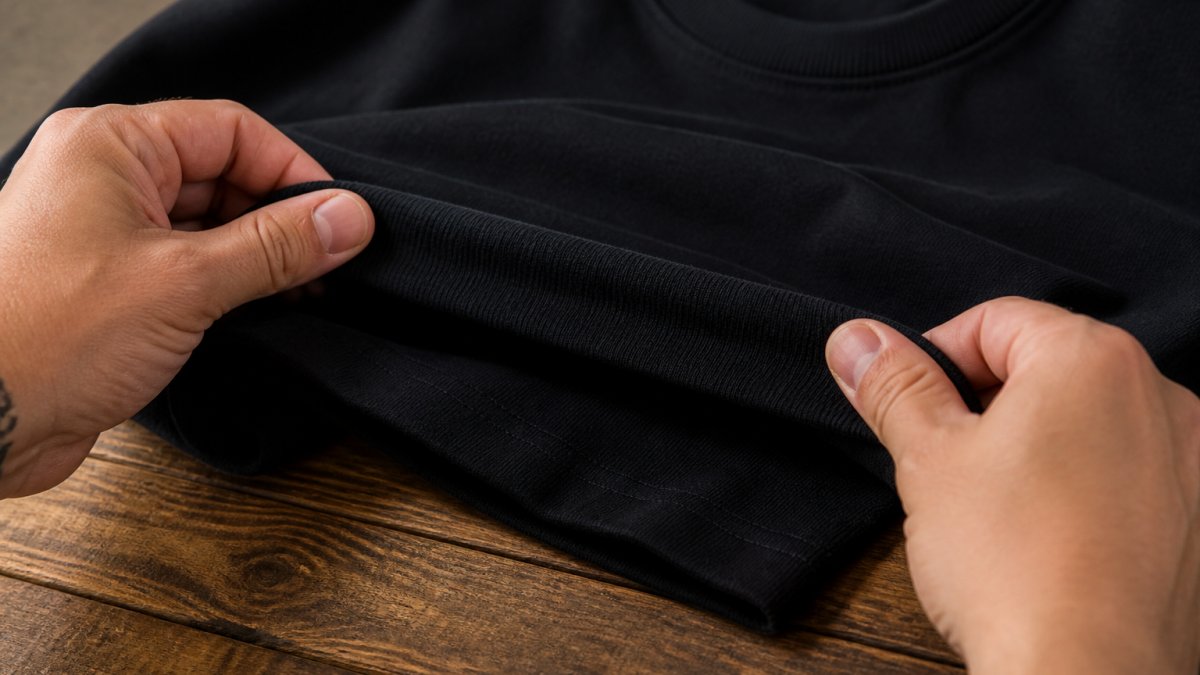
- Hold it to light. A heavyweight tee should block light. If you can see your hand through it, it is too thin.
- Stretch the collar. A wide ribbed collar that snaps back is built to last. A thin one that stays stretched will sag.
- Pinch the fabric. Dense cloth feels substantial between your fingers, not flimsy.
- Check the seams. Double-stitched hems and side seams hold up better than single stitching.
- Feel the surface. Smooth and tight beats rough and loose at the same weight.
Separating Fabric Weight From Perceived Thickness
Here is what most guides miss: weight and thickness are not the same thing. A tightly knit lightweight fabric can feel thicker than a loosely knit heavier one.
Density, yarn size, and knit structure all change how thick a shirt feels. A low-gauge knit with thick yarn feels chunky. A high-gauge knit with fine yarn feels smooth even at the same GSM.
Wash Performance, Shrinkage, and Long-Term Durability
Heavyweight cotton holds its shape better through repeated washing than lighter fabric. The denser knit resists stretching, sagging, and the thin spots that show up in cheap tees after a few cycles.
Shrinkage is still a factor. Cotton shrinks, especially on the first hot wash. Expect one to three percent shrinkage on a quality tee, more on a loosely knit one.
To protect your investment:
- Wash cold and tumble low, or hang dry
- Turn the shirt inside out to protect any print
- Skip the dryer on high heat, which speeds shrinkage and wear
- Wash with similar colors to avoid transfer
A well-made heavyweight tee keeps its collar shape, resists pilling, and holds its drape far longer than a midweight one. That durability is the whole point of paying more upfront.
Conclusion: Buy Heavyweight Cotton With Confidence
The gap between a real heavyweight tee and a thin one comes down to a few checkable details: the GSM number, the fiber content, the collar construction, and how the fabric feels in your hand. Learn to read those signals and you will never overpay for a shirt that claims to be heavy but is not.
At EVRMORE, our tees are built for people who have rebuilt themselves and want clothing that lasts. The Oversized Heavyweight Streetwear Tee uses 9 oz ring-spun cotton-poly fabric with dropped shoulders and a wide ribbed collar. The Rescued Redeemed Restored Christian Heavyweight Shirt brings the same super-heavyweight build with a structured drape. Both are made to hold up wash after wash.


Add to cart and wear something built to last.
Frequently Asked Questions
What does GSM mean for T-shirts?
GSM stands for grams per square meter, a metric measurement of fabric weight. A standard cotton t-shirt usually falls between 140 and 180 GSM, while heavyweight cotton starts around 200 GSM and can go above 300 GSM. If you see ounces per square yard instead, multiply by 33.9 to get GSM. For example, 9 oz equals roughly 305 GSM. Checking the GSM on a product label is the fastest way to compare heavyweight cotton t-shirts before you buy.
Can you tell a T-shirt's weight by feel alone?
Feel gives you useful clues but is not a precise measurement. A heavyweight cotton t-shirt typically feels dense and substantial, with less light passing through when you hold it up. It also resists stretching and springs back into shape. However, softness and thickness can be misleading because fabric finishes and cotton type affect hand feel. For accuracy, combine feel with label data like GSM or ounces per square yard, and if possible weigh the shirt at home.
Is a heavyweight T-shirt always made from 100% cotton?
No. Heavyweight cotton t-shirts often blend cotton with polyester to improve durability, reduce shrinkage, or add stretch. A cotton/poly blend, for example, can feel substantial while keeping its shape after repeated washing. If you want pure cotton, check the fiber content label. Look for 100% cotton or terms like combed or ring-spun cotton. Blends are not lower quality automatically; they serve different performance goals.
How do I check T-shirt quality beyond fabric weight?
Inspect the collar, seams, and hem. A wide ribbed collar with double stitching resists stretching. Look for even, tight stitching along the shoulders and side seams. Hold the shirt up to light to check for thin spots. Check the fiber content and fabric construction details on the label. Finally, wash it according to care instructions and see how it holds up after a few cycles. Quality shows in how the shirt recovers, not just how it feels in the store.



Leave a comment
This site is protected by hCaptcha and the hCaptcha Privacy Policy and Terms of Service apply.